
The hidden cost of Tech Neck
Why your rounded upper back and your leaky sneezes are the exact same problem, reflected back on each other.

Check in with your body right now.
Are your shoulders creeping up toward your ears?
Is your chin jutting forward toward the screen?
If your ears aren’t stacked over your shoulders, and your chin is forward of your chest, 🥳 👎 sad congrats, you’ve got Tech Neck.😭

What is Tech Neck?
Tech Neck is the postural pattern that develops when we spend hours looking down at phones, laptops, and other screens. Over time, our body adapts by letting our head drift forward, our shoulders round, and our upper back stiffens.
While the discomfort often shows up as a sore neck or tight shoulders, the real problem isn’t just your neck; it’s how your entire body has reorganized around that forward posture.
Most people treat Tech Neck like a head-and-shoulder issue. You catch yourself slouching, try to sit up straight, roll your neck a few times, and move on. Maybe you book a massage or get a quick chiropractic adjustment. But your head inevitably creeps forward again, and your shoulders collapse back in.
Why? Because you haven’t fixed the underlying structural issue: a broken stack.
What happens from the chest up is mirrored from the chest down. When your neck collapses forward, your whole alignment shifts, and your pelvic floor goes right along with it.
Your leaking problems might not actually be because of a weak pelvic floor. They often start with your stack.
Your what? Your STACK. How the bell of the ribcage should, most of the time, be STACKED over the bowl of your pelvis.
Get Stacked.
A Deeper Look at the Stack: Ribs Over Pelvis
Your spine moves as a single, interconnected chain linking your head, ribs, and pelvis. Shift one link out of position, and every segment above and below has to compensate. To move and breathe with ease, we want an optimal stack of the ribs directly over the pelvis.
When that alignment breaks down—say, while leaning into a screen—a rapid cascade occurs:
Your head juts forward toward the display.
Your shoulder blades slide wide, rounding toward the front of your body.
Your sternum sinks inward, collapsing your upper chest and side-body while compressing your internal organs.
Your lower front ribs flare open as a survival mechanism—forcing your eyes back up to the horizon and opening airway space.
That rib flare angles your diaphragm forward, redirecting natural breath pressure straight down into your pelvic floor rather than allowing for a spacious, 360-degree expansion.
The driver behind this whole chain reaction is simple physics. In a neutral stack, your head weighs roughly 10 to 12 pounds. But tilt it forward just a few inches, and the load multiplies. As spine surgeon Dr. Kenneth Hansraj demonstrated in a landmark 2014 study, forward head posture can exert anywhere from 30 to 60 pounds of continuous force on your cervical spine.
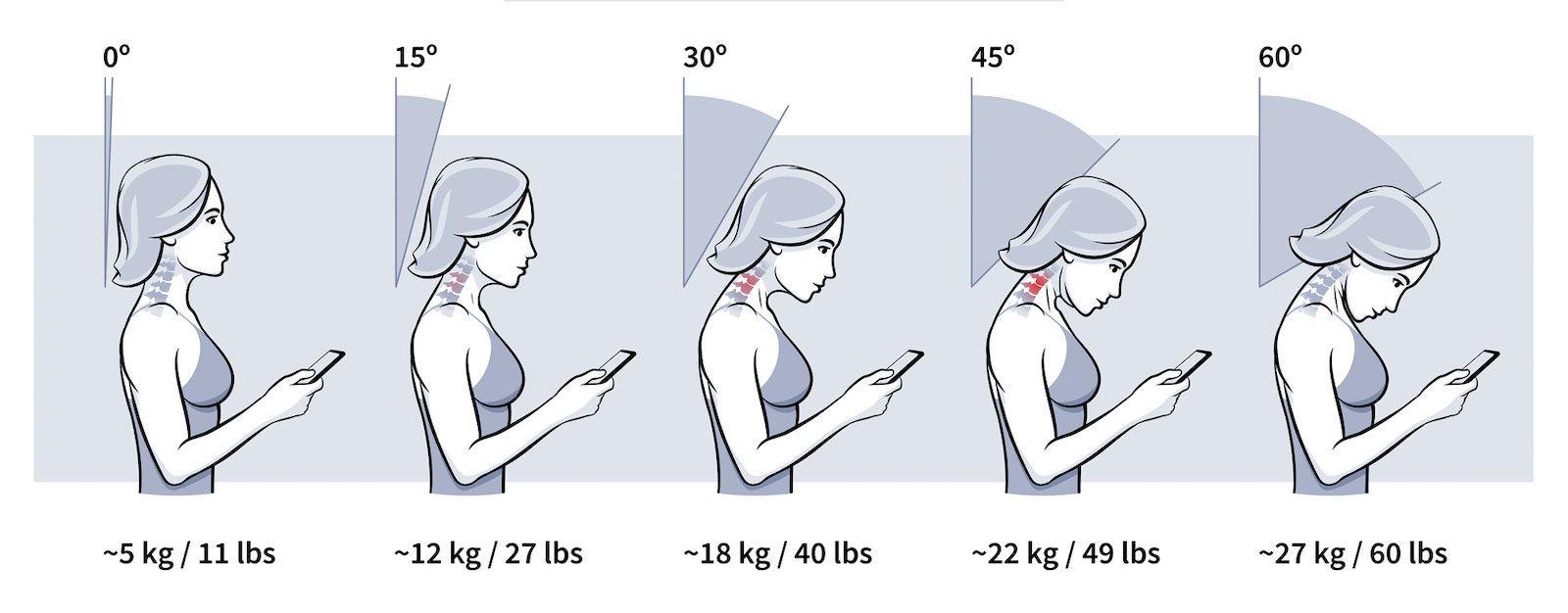
A rounded neck isn’t just a cosmetic posture issue; it’s a mechanical force multiplier. Since your cervical spine (neck) and lumbar spine (low back) mirror each other, a collapse at the top forces the bottom of the system to adapt. This builds on the same connected biomechanics discussed in my previous article on how your jaw, breath, and pelvic floor are connected.
Focus on Your Core as a Canister, Not a Six-Pack
Rather than a flat sheet of abdominal muscle running from ribs to hips, think of your core as a dynamic, wrap-around canister:
Top lid: Diaphragm
Bottom: Pelvic floor
Walls: Abdominals, obliques, and deep spinal stabilizers
When your stack is aligned, these two “lids” remain more or less parallel. As you inhale, the diaphragm descends, expanding the canister evenly in 360 degrees while the pelvic floor yields to accommodate the downward pressure.
Tech Neck disrupts the neutral stack of your core. As the head shifts forward, the front of the rib cage slumps downward while the pelvis tucks up underneath to compensate. Rather than sitting level, the front edges of the rib cage and pelvis fold toward one another, compressing the front of your abdominal container and forcing the upper back to round.
In this collapsed position, the diaphragm can no longer move efficiently. Instead of pressure expanding evenly into your rib cage and abdomen, it gets redirected downward. Every breath, cough, sneeze, laugh, or lift sends more force toward the pelvic floor and bladder, making leaks and pelvic floor symptoms more likely over time.
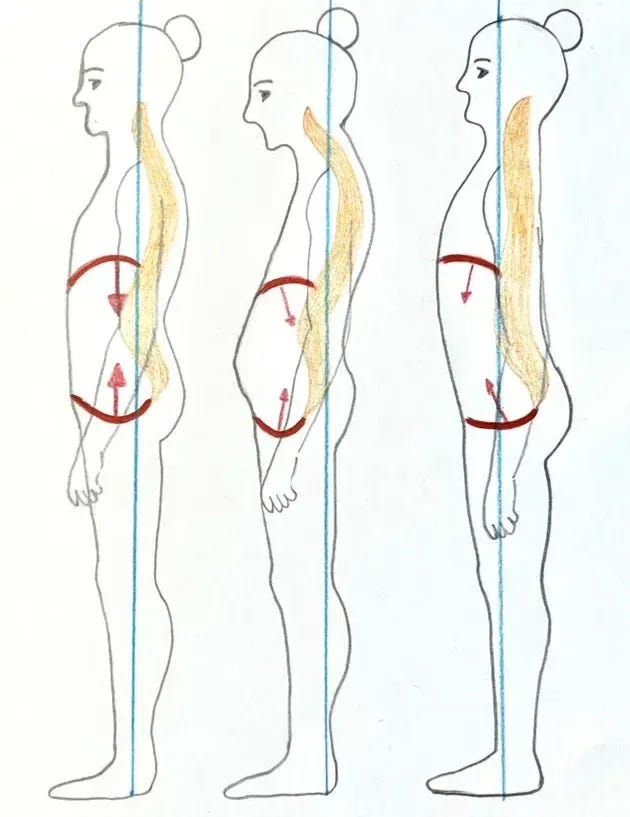
This is why managing internal pressure is central to the Unleakable framework, rather than simply doing more Kegels. Experiencing leaks while sneezing, running, or jumping is rarely caused by a weak pelvic floor; more often, it is an exhausted muscle group bearing unmanaged pressure from higher up in the kinetic chain. Read more about this in Kegels vs. Yoga for Pelvic Floor Health.
The 30-Second Alignment Reset
Instead of isolated neck rolls or squeezing your pelvic floor while slouched over a desk, try this reset:
Unweight the head: Gently slide your ears back over your shoulders until your collarbones feel open and broad.
Re-stack: Reset the bell of the rib cage over the bowl of the pelvis.
Find a long side body: Sit up tall. Create space between armpits and hips.
Drop the sternum: Soften your front ribs down rather than flaring outward.
Breathe into the back ribs: Place your hands on the sides of your lower ribs. Take a slow inhale through your nose, expanding your ribs outward into your hands rather than pushing your belly forward.
For a full audit on viewing hips, ribs, and the pelvic floor as one connected system, read How to Fix Your Posture for Optimal Pelvic Floor Health. To follow along with guided movement exercises, explore these reset techniques on YouTube.
Stack First, Strength Second
Tech Neck isn’t just a neck problem—it’s a pressure problem. When your head, ribs, and pelvis aren’t stacked, your pelvic floor ends up working harder than it should.
Before you blame a weak pelvic floor or do another set of Kegels, check your posture, your breath, and your stack. Often, that’s where the real change begins.
Want to learn how to put this into practice? My Yoga for the Pelvic Floor classes teach the breathing, alignment, and movement strategies that help your entire core system work together, so your pelvic floor doesn’t have to do all the heavy lifting.
Join an upcoming class and start building an Unleakable body from the inside out!
If this article changed the way you think about your posture, imagine how many other people are unknowingly carrying the same patterns. If it resonated with you, share it with someone who might need it.
Have a question or a topic you’d like me to explore next? Leave a comment or send me a message. I would love to hear from you!